
How Do Property Taxes on a New Home in Palm Coast, FL Work If It Finishes After January 1?
The situations described here are composites drawn from the types of jobs and decisions we encounter regularly. Names and specific figures are illustrative.
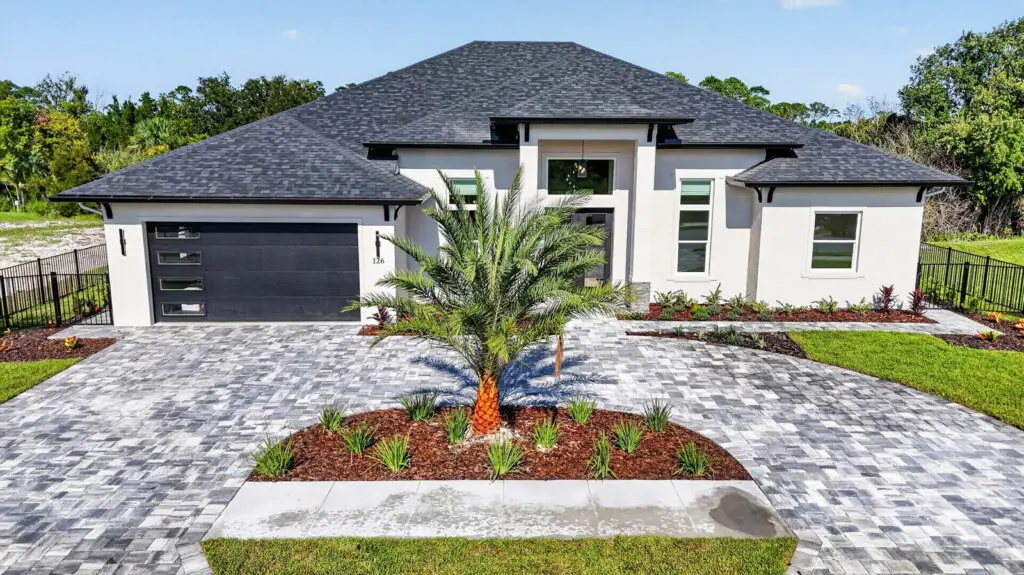
A retired couple from New Jersey bought a lot in Seminole Woods last spring and is building a Cecile with us, the three-bedroom, three-bath, 2,650-square-foot plan. The house is at drywall now, and their project manager expects it to be substantially complete in early February 2027. Their Flagler County tax bill for the lot was mailed on October 31, the date the county tax collector sends real estate bills[1]. That bill prompted the question they brought to their weekly update: how do property taxes on a new home in Palm Coast, FL actually work when the house finishes a few weeks after January 1? The answer turns on one date in state law, and it is not the closing date or the move-in date.
The date the county looks at
Florida values real property as of January 1 each year. The statute also says that improvements not substantially completed on January 1 have no value placed on them, and it defines substantially completed as the improvement, or some self-sufficient unit within it, being usable for the purpose it was built for[2].
For this couple that means the 2027 assessment will look a lot like the 2026 one. On January 1, 2027, the Cecile will have walls, a roof and drywall, but no finished kitchen, no final inspections and nobody able to live in it. The county will value the parcel as land. The house shows up on the roll a year later, on January 1, 2028, at its full value.
The husband had assumed the opposite. He expected a prorated charge for the house as soon as it was finished, the way he understood it to work back home. Florida’s rule works on the single January 1 snapshot instead, so a house finished in February is not on the next tax bill at all.
Why the homestead exemption waits a year too
The second question was about the homestead exemption. They own the lot already, so the wife wanted to know if they could file for 2027.
The Florida Department of Revenue’s homestead guidance answers that with the questions the property appraiser asks first-time applicants: whose names were on the title on January 1, and whether the applicants were living in the dwelling on January 1. A person who owns the property and makes it a permanent residence by January 1, and files with the county property appraiser, may be eligible for that tax year[3]. Owning a lot on January 1 is not the same as living in a house on it. Their first realistic homestead year is 2028, with the application due to the Flagler County Property Appraiser by March 1, 2028[3].
The same guidance puts the exemption at up to $50,000 under current law. The first $25,000 applies to all property taxes, including school taxes, and the second applies only to non-school taxes on assessed value above $50,000[3]. Once the exemption is in place, Florida’s homestead assessment law limits how much the assessed value can rise each year. Starting the year after the property receives the exemption, the annual increase cannot exceed 3 percent or the change in the Consumer Price Index, whichever is lower[4].
Here is how the dates lined up for their build when we wrote them out at the meeting.
| Date | What happens | What it meant for this build |
|---|---|---|
| October 31, 2026 | Flagler County mails real estate tax bills[1] | The 2026 bill covers the lot only |
| January 1, 2027 | Assessment date; unfinished improvements get no value[2] | House still under construction, so 2027 is valued as land |
| February 2027 | Expected substantial completion and move-in | No change to the 2027 bill |
| January 1, 2028 | House on the roll at full value[2]; residency tested for homestead[3] | First year the house is taxed and first homestead year |
| March 1, 2028 | Homestead application deadline[3] | File with the property appraiser after moving in |
| January 1, 2029 | Annual assessed value increase capped at 3% or CPI, whichever is lower[4] | The cap starts working on their assessment |
The idea of finishing before Christmas
Once they saw the table, the husband asked whether it made sense to push the build to finish in December and move in before January 1. That would get them homestead a year earlier.
We walked through it the other way around. If the house were finished and occupied on January 1, 2027, the 2027 assessment would include the whole house, minus a homestead exemption of up to $50,000[3]. If it is finished in February, the 2027 assessment is the lot, with no exemption. On this build, the finished house will be worth several times what the lot is, so the lot-only year is the smaller bill. An earlier homestead year does not make up for adding the full value of a new house to the roll a year sooner.
There was also the practical side. Rushing a schedule means paying for overtime, stacking trades on top of each other and accepting less time between inspections. Spending money to speed the house up would have cost them twice: once in construction and again on the 2027 tax bill. That was the point where paying more stopped making any sense, and they let the February date stand.
“Our builds run five to eight months, and contractor availability, materials and permitting can move that. Every client has a dedicated project manager who sends regular updates and photos, so you know where the house stands at every stage.”
Owner, Wise Choice Custom Homes
The other cost that changes when a new house is finished is insurance, and that one starts at closing rather than on January 1. We wrote about how a new block home’s construction affects Florida insurance premiums for a family comparing a resale to a build.
The amendment that made residency a date to watch
The couple had also seen news coverage of a property tax amendment. The Legislature placed it on the November 3, 2026 general election ballot during a June special session. It needs 60 percent of voters to pass. Among other changes, it would expand the homestead exemption for non-school taxes, and people who move to Florida after December 31, 2026 would start with a smaller exemption[5].
The Volusia County Property Appraiser, next door to Flagler, published a plain explanation of how the proposal would work. Current law stays in effect unless the amendment is approved. If it is approved, it takes effect January 1, 2027[6].
| Item | Florida resident by Dec. 31, 2026 | Florida resident on or after Jan. 1, 2027 |
|---|---|---|
| Non-school homestead exemption if the amendment passes | Up to $150,000 in 2027 and up to $250,000 in 2028[6] | Starts at $50,000, adjusted by CPI beginning in 2028[6] |
| When the larger exemption applies | When they buy a home and apply for homestead[6] | After four years of homestead, starting January 1 of the fifth year[6] |
| School tax exemption | $25,000[6] | $25,000[6] |
For people building a house in Palm Coast right now, that table moves the residency date to the front of the conversation. This couple’s house will not be finished until February, and under current law that only affects when their homestead starts. If the amendment passes, the date they became Florida residents could also affect how large the exemption is for their first four years.
We were careful about what we could tell them. The Volusia appraiser’s page says some administrative details will not be settled until implementing legislation is passed, and that it cannot calculate anyone’s exact savings yet[6]. We build houses. We are not tax advisors, and nobody at that table could say how residency will be documented for a rule that has not passed. What we could do was give them a firm completion estimate and the build documents they might need.
Their decision was to move up the move they had already planned. They had a furnished rental in Palm Coast lined up for the spring. They moved the lease start to December 1, and they are talking with their own attorney about the residency steps. The state’s homestead guidance lists the kinds of records a property appraiser may ask for: a Florida driver license, a Florida vehicle license plate number, Florida voter registration, a declaration of domicile and the address on the last federal tax return[3]. If the amendment fails, the earlier move costs them a few months of rent they would have paid in the spring anyway. If it passes, they will have a paper trail that starts in 2026.
What people usually ask at this point
The first question is almost always whether the builder or the county decides when a house is substantially complete. The county property appraiser applies the statute’s test: whether the house, or some self-sufficient unit within it, can be used for what it was built for[2]. Our part is the paperwork and the schedule, so the project manager tracks where the house stands as January 1 approaches.
The second is whether they can carry a homestead over from another state. They cannot. Portability in Florida applies to people moving from one Florida homestead to another Florida homestead[3]. A New Jersey house does not count, so their assessment starts fresh at the new home’s value.
The third is about paying the lot bill. Florida gives a 4 percent discount for paying in November, then 3 percent in December, 2 percent in January and 1 percent in February[7]. On a lot bill the dollar amount is small, but the same schedule applies to every bill they will get on the finished house.
The last is what the house will cost to own each year once it is finished. That depends on the full value the appraiser places on the home and the rates the taxing authorities set, and neither is known yet for 2028. We have had a similar conversation about what goes into the price of a Palm Coast build per square foot, and the same advice holds: compare what each number includes. Engineered plans, permit fees, surveys and soil tests are part of our standard features, so they are in the contract price and not added later.
What the couple took home
They left with a one-page timeline, a February completion estimate and a short list of questions for their attorney. The house will be built on the same schedule it was always on. The 2027 bill will be for the lot. The house goes on the roll in 2028, the homestead application goes in by March 1 of that year, and the residency question is now in the hands of someone qualified to answer it.
For anyone building now, the date to keep in mind is January 1, not the closing date. Where your finish date falls relative to that day decides which year the house is first taxed and which year homestead can start. That is the practical side of property taxes on a new home in Palm Coast, FL, and it is worth writing out before the house is finished rather than after the first full bill arrives. The Cecile floor plan this couple chose is on our models page, and if you are planning a build of your own you can reach our team here.
Sources
- Flagler County Tax Collector: Tax Bills Mailed, Flagler County Tax Collector, 2026
- Florida Statutes 192.042, Date of assessment, The Florida Senate, 2025
- Property Tax Information for Homestead Exemption (PT-113), Florida Department of Revenue, 2025
- Florida Statutes 193.155, Homestead assessments, The Florida Senate, 2025
- Florida voters to decide expanded homestead tax exemption amendment in November, Ballotpedia News, 2026
- Proposed 2026 Florida Property Tax Amendment 3, Volusia County Property Appraiser, 2026
- Florida Statutes 197.162, Tax discount payment periods, The Florida Senate, 2025