
Can Hiring a Custom Home Builder in Palm Coast, FL Really Cut Your Florida Insurance Bill?
The situations described here are composites drawn from the types of jobs and decisions we encounter regularly. Names and specific figures are illustrative.
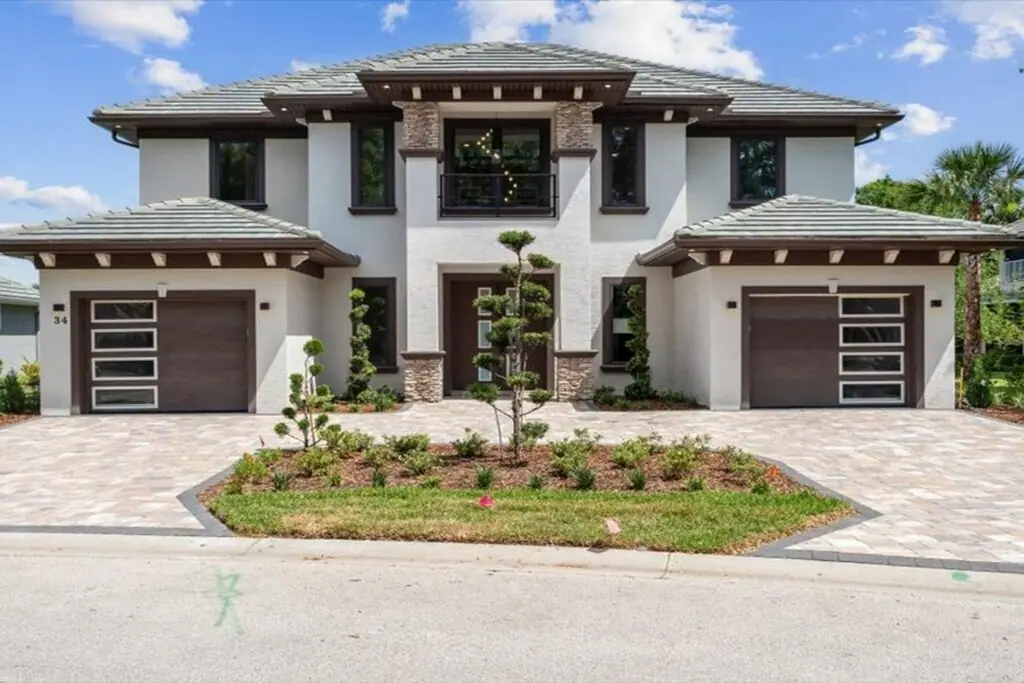
A couple owned a 1998 concrete-block house in the B-section of Palm Coast. They finished a new kitchen and two new bathrooms, and the next homeowners insurance renewal went from $3,200 to $5,900 a year. They priced a wind retrofit at $45,000 to $55,000, then compared it with selling and hiring a custom home builder in Palm Coast, FL to build a new house. The new home’s first-year premium came in near $3,100. The rest of this post is how they got from the renewal letter to that decision, and what has changed in the rules during 2026.
What the renewal was actually pricing
Their first assumption was that the renovation should have helped. It did not, because a carrier does not price countertops. It prices how the structure is expected to hold up in a windstorm. Florida law spells this out: residential property rate filings must include discounts or credits for construction features shown to reduce wind losses, including roof strength, roof-to-wall strength, wall-to-floor-to-foundation strength and opening protection[1]. Credits for features that meet the minimums of the Florida Building Code have to be in the filing, and since October 1, 2023, each insurer has had to describe its hurricane mitigation discounts on its website[1].
Their agent pulled the wind mitigation report on file. The house had a gable roof, its original windows with no impact rating or shutters, and roof trusses tied to the block with clips, not wraps. The kitchen was not on the form anywhere.
What the inspection form looks at, and what changed in April
The document behind those credits is the state’s Uniform Mitigation Verification Inspection Form, OIR-B1-1802. It asks which building code the house was built under, with answers for the 2001/2004 Florida Building Code, the 2007 code or later, or unknown. It then covers roof covering, roof deck attachment, roof-to-wall attachment (toenails, clips, single wraps, double wraps or structural), roof geometry, secondary water resistance and opening protection[2]. A roof counts as a hip roof on the form only if non-hip features make up no more than 10 percent of the total roof perimeter, and standard underlayment or hot-mopped felt does not count as secondary water resistance[2]. Each feature has to be backed by at least one photo or document, and a completed form is valid for up to five years if the structure does not change[2].
The form was revised this year. The new version, Rev. 04/26, took effect April 1, 2026, and inspections done on or after that date must use it[3]. It adds a region based on design wind speed, a roof slope question for homes with more than one slope, and lets FORTIFIED Home Roof, Silver and Gold certificates support certain features[3]. Citizens told agents the changes do not alter the credits it applies at this time, and that it will still accept the older version if it was completed within five years before April 1, 2026 and nothing on the house changed[3]. For a homeowner, the practical point is simple. If your last wind mitigation report is close to five years old, or you have changed the roof or windows since, a new inspection will be on the 2026 form.
Here is how the couple’s old house and the new build lined up on that form.
| Form item | 1998 B-section house | New build |
|---|---|---|
| Building code | Built before the 2001 Florida Building Code, so “unknown or does not meet” | 2007 code or later |
| Roof-to-wall attachment | Clips | Hurricane straps, inspected and photographed during framing |
| Roof geometry | Gable | Hip (the plan they chose) |
| Secondary water resistance | None | Sealed roof deck, priced as a selection |
| Opening protection | Original windows, no shutters | Impact-rated glass, priced as a selection |
The roof clock they had not noticed
The roof on the old house had been replaced in 2011. That made it 15 years old in 2026, and that detail mattered more than the couple expected. Under Florida law, an insurer may not refuse to issue or renew a policy solely because of roof age when the roof is less than 15 years old[4]. Once a roof reaches 15, the insurer must let the homeowner pay for an inspection by an authorized inspector before requiring replacement, and it cannot refuse coverage solely for age if the inspection shows at least five years of useful life left[4]. That protects owners, but it also means a roof past 15 years becomes a recurring conversation at renewal.
Their 2011 roof did have one thing going for it. Because it was installed under the 2007 Florida Building Code or later, a repair covering 25 percent or more of that roof only requires the repaired portion to meet the current code, not the whole roof[5]. That would have kept a storm repair smaller. It did not change the gable shape, the clips or the windows.
Pricing the retrofit honestly
A contractor quoted a new roof with a sealed deck, upgraded roof-to-wall connections where they could be reached, and impact windows and doors. In this illustration, the total ran $45,000 to $55,000. Florida’s My Safe Florida Home program offers free wind mitigation inspections and, for eligible homeowners, grant funding of up to $10,000 toward approved improvements[6]. Even if they qualified, most of the cost stayed with them, and the money would have gone into a house whose code year, roof shape and floor plan were not going to change. They had also outgrown the plan.
This is the point where spending more on the old house stopped making sense to them. A retrofit improves the form. It does not move the house into the “2007 or later” box, and it does not give them the layout they were renovating toward.
What the new house was built with
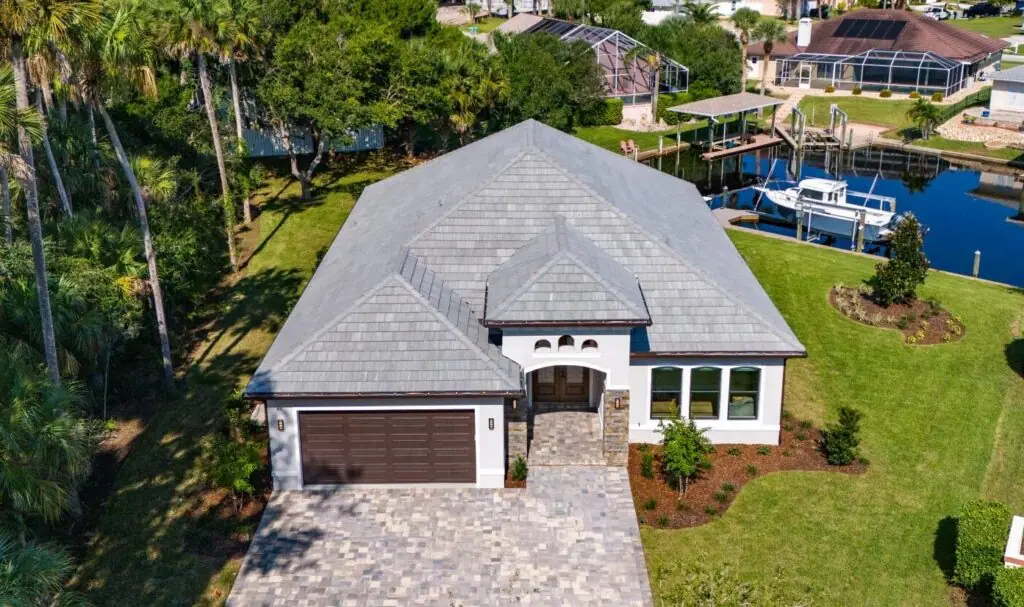
They sold and built with WCC Homes. Some of the wind items come with every home, and some were choices. The standard features list includes a steel-reinforced monolithic slab, continuous poured tie beams with steel, concrete block exterior walls, structurally engineered roof trusses and hurricane straps throughout the roof. The standard windows are double-pane, low-E insulated units. Because the finish packages are customizable, the couple asked for impact-rated glass and a sealed roof deck to be priced as selections, and they picked a plan from the home models page with a hip roof.
“Hurricane straps throughout the roof are standard on every home we build, along with concrete block walls and continuous poured tie beams with steel. The roof-to-wall connection is one of the items on the state’s wind mitigation form.” [2]
Owner, Wise Choice Custom Homes
The straps matter on the form because the inspector needs proof. On a new build, the connections can be photographed while the trusses are still open, before drywall and insulation hide them. On the old house, the inspector had to work from the attic and record the weakest connection found.
Timing came up too. The Florida Building Commission’s workplan lists December 31, 2026 as the effective date of the 9th Edition (2026) Florida Building Code, with the 8th Edition (2023) in effect until then[7]. A house permitted this fall is reviewed under the 8th Edition, and one permitted in early 2027 under the 9th. For the inspection form, either one lands in the “2007 or later” category[2]. The edition change mostly affects plan review and paperwork, and a builder can tell you which edition your permit will fall under.
Running the ten-year numbers
One year of premium savings does not justify a new house. Ten years of it, combined with a plan they wanted, was closer. This is the comparison they made at the kitchen table, using their own illustrative figures.
| Item (illustrative) | Keep and retrofit | Sell and build new |
|---|---|---|
| Upfront wind work | $45,000 to $55,000 | Included in the build price, plus selections |
| Year-one premium | Roughly $4,000 to $4,500 after credits (carrier estimate) | About $3,100 |
| Roof age at renewal | New roof, but 1998 structure | New roof and new structure |
| Floor plan | Same layout they had outgrown | Plan they chose |
Building new was not free. They paid selling costs, carried two housing costs for part of the build, and lived with a five-to-eight-month timeline. The insurance gap was one input among several, and it was the one that pushed them to run the numbers at all.
The questions that came up along the way
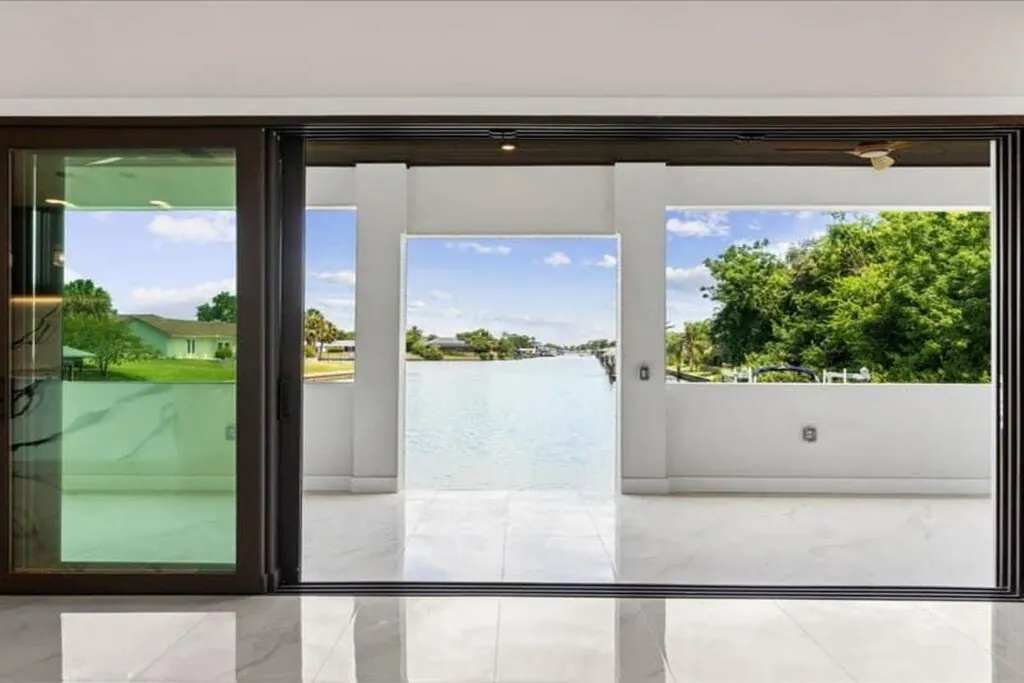
People in this spot usually ask the same few things. The first is whether a new house automatically gets the lowest premium. It does not. Credits follow the specific features documented on the form, and every carrier files its own rates[1]. A large opening like the sliding doors in the photo above is a good example: whether it is impact-rated or protected changes the opening protection answer.
The second is flood. Wind credits do nothing for flood, and flood is a separate policy. For homeowners who end up with Citizens, the phase-in set by the Legislature is close to finished: since January 1, 2026, policies with wind coverage and a dwelling value of $400,000 or more must carry flood insurance, and starting January 1, 2027 that applies to all such policies regardless of value[8]. Lot location matters here, and a past account of a canal lot whose flood zone surprised its buyers covers that side of the decision.
The third is paperwork. Ask for the wind mitigation inspection at the end of the build, keep the framing photos, and send both to your agent before the first policy is bound. The form is good for up to five years if nothing changes[2]. Buyers comparing builders in coastal sections often bring these questions up early, as in this story of Hammock Beach retirees choosing a builder in October.
What the couple took from it
The renovation made the house nicer to live in. It did not make it cheaper to insure, because the insurer was looking at the code year, the roof shape, the connections and the openings. For an older Palm Coast house, the useful first step is to read the current wind mitigation report line by line and see which answers can realistically change. If most of them cannot, the comparison with building new is worth running over ten years, not one.
For anyone weighing a custom home builder in Palm Coast, FL against another round of upgrades, the insurance quote is a reasonable place to start. It shows what a carrier thinks of the structure, and that does not change with new cabinets.
If you want to talk through a build with wind-rated features in Palm Coast, you can reach out to our team here.
Sources
- Section 627.0629, Florida Statutes: Residential property insurance; rate filings, The Florida Senate (2025)
- Uniform Mitigation Verification Inspection Form, OIR-B1-1802 (Rev. 04/26), Florida Office of Insurance Regulation (2026)
- Uniform Mitigation Verification Inspection Form Changes, Citizens Property Insurance Corporation (March 2026)
- Section 627.7011, Florida Statutes: Homeowners’ policies; offer of replacement cost coverage and law and ordinance coverage, The Florida Senate (2025)
- Section 553.844, Florida Statutes: Windstorm loss mitigation; requirements for roofs and opening protection, The Florida Senate (2025)
- My Safe Florida Home Program, Florida Department of Financial Services (2026)
- 9th Edition (2026) FBC Code Update Development Tasks, Workplan October 2026, Florida Building Commission (2026)
- Citizens’ Flood Insurance Requirements, Citizens Property Insurance Corporation